Modern education has achieved remarkable success in delivering information and developing technical skills. However, educators across the world are increasingly facing challenges such as declining attention spans, excessive screen dependency, stress, anxiety, lack of concentration, emotional instability, and reduced creativity among students.
While educational systems focus heavily on external knowledge, ancient Indian wisdom emphasizes the development of the inner instrument of learning—the mind itself. Yogic science identifies the Ājñā Chakra, commonly known as the Third Eye, as the center governing concentration, perception, intuition, mental clarity, and higher cognitive functions. Vedic Mānas Yoga offers a unique bridge between ancient wisdom and modern educational needs by providing systematic techniques to strengthen mental faculties, enhance awareness, and awaken the latent potential within every learner.
What is the Ājñā Chakra?
The Sanskrit word “Ājñā” means command, direction, or authority. Located between the eyebrows, the Ājñā Chakra is traditionally regarded as the command center of consciousness and the gateway to higher intelligence. Ancient yogic texts associate this chakra with: Concentration and focus, Memory and recall, Intuition and insight, Observation and awareness, Mental discipline, Decision-making ability, Imagination and creativity & Emotional balance. When the Ājñā Chakra is active and balanced, the mind becomes more organized, attentive, and capable of deeper understanding.
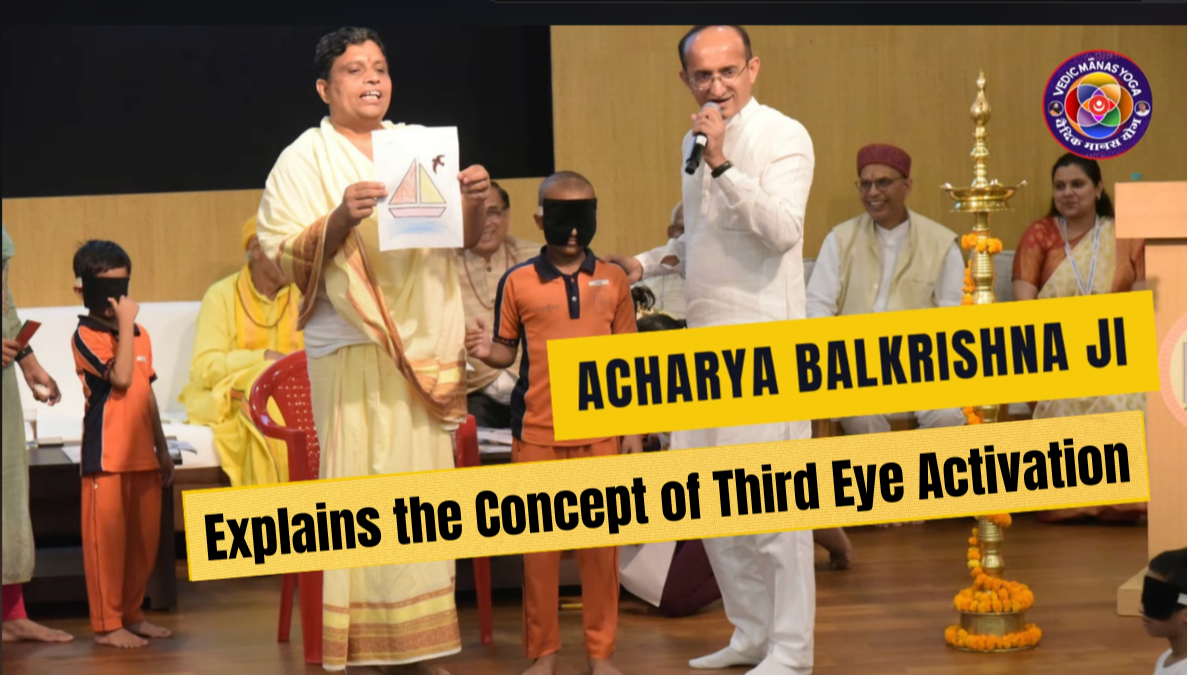
Understanding Third Eye Activation
The concept of Third Eye Activation is often surrounded by misconceptions. In authentic yogic traditions, it does not refer to supernatural powers but to the awakening of higher awareness and refined mental capabilities.
Third Eye activation can be understood as the development of: Enhanced concentration, Greater self-awareness, Improved observation skills, Better cognitive processing, Emotional intelligence, Creative thinking & Intuitive understanding. It is essentially a process of training the mind to function at its highest potential.
Shraddhey Balkrishna Acharya ji explains why Modern Education Needs Third Eye Development ?
Today’s students are exposed to unprecedented levels of information. However, information alone does not guarantee intelligence, wisdom, or effective learning. The major challenges faced by students include:
1. Reduced Attention Span
Constant exposure to digital devices has made sustained attention increasingly difficult. Students often struggle to focus for extended periods.
2. Memory Overload
Students are expected to process large amounts of information, yet many lack effective memory-development techniques.
3. Academic Stress
Competition, examinations, and performance pressure contribute significantly to anxiety and mental fatigue.
4. Lack of Emotional Regulation
Many students possess intellectual capabilities but struggle with self-confidence, emotional balance, and resilience.
5. Limited Creativity
Education often emphasizes memorization rather than imagination, innovation, and intuitive thinking. The qualities associated with the Ājñā Chakra directly address these challenges.
Scientific Relevance of Ājñā Chakra Development
Although yogic terminology differs from modern neuroscience, there is increasing recognition that practices involving focused attention, mindfulness, visualization, breath regulation, and meditation positively influence cognitive functioning.
Research suggests that such practices can improve: Attention and concentration, Working memory, Emotional regulation, Learning efficiency, Stress resilience, Cognitive flexibility & Executive functioning.
These are precisely the skills required for success in twenty-first-century education.
Vedic Mānas Yoga: A Holistic Educational Approach
Vedic Mānas Yoga is a unique mind-training methodology developed by integrating ancient Vedic and Yogic principles with modern scientific understanding of learning and cognition. Its objective is not merely academic excellence but the holistic development of human potential.
The training focuses on: Awareness development, Concentration enhancement, Memory strengthening, Observation skills, Mental discipline, Emotional balance, Character building& Cognitive development.
Through structured exercises, students learn how to use their minds more effectively rather than simply accumulating information.
How Vedic Mānas Yoga Supports Ājñā Chakra Activation
1) Awareness Training-Students are taught to observe their thoughts, surroundings, and actions consciously. Increased awareness improves learning efficiency and reduces mental distractions.
2) Concentration Practices- Specialized focus-building exercises help students sustain attention for longer periods and improve academic performance.
3) Memory Development Techniques- Systematic memory training strengthens retention, recall, and information organization.
4) Visualization Exercises- Mental imagery and visualization activate creative thinking, imagination, and problem-solving abilities.
5) Breath Regulation- Yogic breathing techniques help calm the nervous system, improve emotional stability, and prepare the mind for focused learning.
6) Meditation and Inner Stillness- Meditative practices reduce mental clutter and promote clarity, self-awareness, and deeper understanding. Together, these methods contribute to the healthy functioning of the faculties traditionally associated with the Ājñā Chakra.
Benefits for Students- Students practicing Vedic Mānas Yoga may experience:
- Improved concentration and attention span
- Enhanced memory and recall ability
- Better academic performance
- Increased self-confidence
- Greater emotional stability
- Reduced examination stress
- Improved creativity and imagination
- Better decision-making skills
- Increased self-discipline
- Greater learning efficiency
Benefits for Teachers and Educational Institutions-Educational institutions implementing mind-development programs can benefit through:
- Improved classroom engagement
- Better student behaviour
- Enhanced learning outcomes
- Reduced stress among students
- Improved teacher-student relationships
- Development of a positive learning environment
- Holistic personality development
Building the Future through Conscious Education
The future of education lies not only in providing information but in cultivating awareness, wisdom, creativity, and emotional intelligence. The development of the Ājñā Chakra symbolizes the awakening of these higher human capacities.
Vedic Mānas Yoga offers a practical and scientifically relevant framework for achieving this goal. By strengthening concentration, awareness, memory, and self-regulation, it helps students become not only better learners but also more balanced and responsible individuals.
Conclusion
The Ājñā Chakra represents the center of perception, wisdom, concentration, and higher awareness. Third Eye Activation, understood through authentic yogic principles, is the process of unlocking these latent human capabilities.
In a world where distraction, stress, and information overload have become common, Vedic Mānas Yoga provides an effective pathway for developing the mental and emotional skills essential for modern education. By integrating ancient yogic wisdom with contemporary educational needs, it empowers students to realize their full potential and prepares them for lifelong success.
The true purpose of education is not merely to fill the mind with information but to awaken the intelligence that already exists within. This awakening is the essence of Ājñā Chakra development and the foundational vision of Vedic Mānas Yoga.